The Digital Catalyst

For decades, the nonprofit sector has operated on the razor’s edge of “doing more with less.” But a new frontier is shifting that paradigm. Artificial Intelligence, once the exclusive playground of Silicon Valley tech companies and high-frequency traders, is migrating into the offices of community food banks, global nonprofits, and environmental advocacy groups. This transition is not merely a technical upgrade; it is a fundamental shift in how social impact is measured and delivered.
The New Toolkit for Social Good
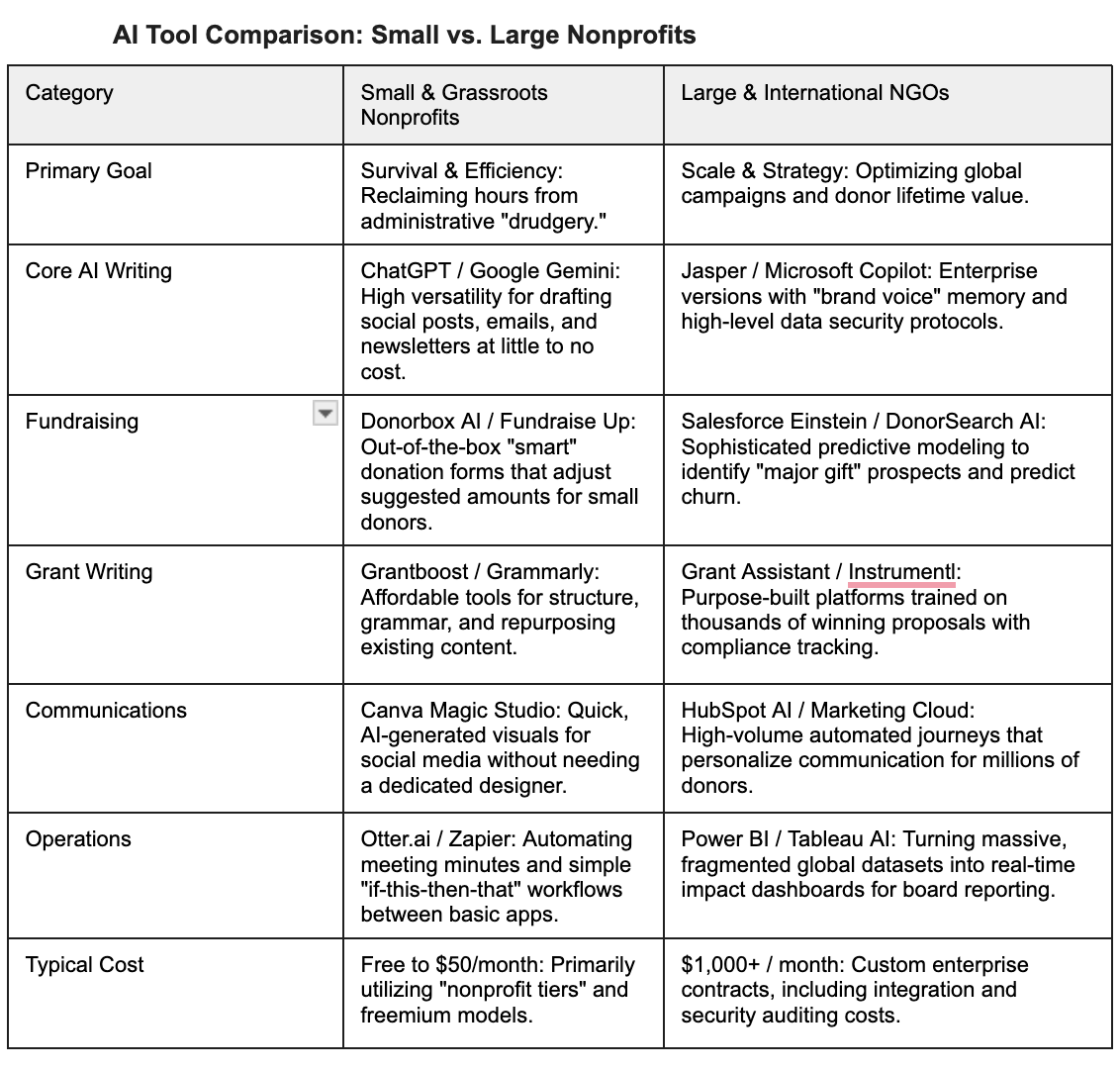
The adoption of AI in the nonprofit world is characterized by a move toward better efficiency. Leading the charge are generative tools like ChatGPT and Claude, which have become the unofficial drafting partners for grant writers and communications officers. By automating the first pass of complex grant applications or translating technical research into accessible donor newsletters, these organizations are reclaiming hundreds of hours previously lost to administrative heavy lifting.
Beyond text, the sector is leaning heavily into adopting predictive analytics. Platforms like Salesforce Einstein or specialized donor-retention software allow organizations to analyze years of giving patterns to predict which supporters are most likely to increase their contributions—and which are at risk of “churning.” Meanwhile, frontline services are being bolstered by AI-driven chatbots. For organizations providing mental health support or legal aid, these interfaces offer immediate, 24/7 triage, ensuring that human intervention is prioritized for the most critical cases.
The Efficiency Paradox: Pros and Cons
The promise of AI lies in its ability to act as a “force multiplier.” When an algorithm can segment a database of ten thousand donors into personalized messaging tracks in seconds, the cost per dollar raised drops significantly. This efficiency allows more capital to flow directly to programmatic work rather than overhead. Furthermore, AI’s ability to process massive datasets enables nonprofits to prove their impact with scientific precision, a requirement increasingly demanded by modern “effective altruism” funders.
However, this digital leap is not without its pitfalls. The most glaring “con” is the inherent risk of algorithmic bias. If a nonprofit uses AI to identify neighborhoods in need of intervention, but the underlying data reflects historical over-policing or under-investment, the AI may inadvertently reinforce systemic inequalities. Additionally, there is the “dehumanization” factor. In a sector built on empathy and trust, an over-reliance on automated responses can alienate the very communities and donors the nonprofit seeks to serve.
The Barriers to Entry
Despite the potential, the road to adoption is blocked by significant structural hurdles. The “digital divide” remains a primary concern; while large nonprofits may have the capital to hire data scientists, local grass-roots organizations and start-ups often struggle with “data silos”—fragmented, messy information stored in aging spreadsheets that AI can’t effectively parse.
The financial barrier is equally daunting. Even when tools are offered at a “nonprofit discount,” the hidden costs of implementation, cybersecurity, and staff training are often beyond the reach of organizations with restricted or minimum funding. There is also a cultural resistance: many social workers and activists are understandably skeptical of “black box” technologies that lack transparency in their decision-making processes.
A Measured Path Forward
As AI continues to permeate the sector, the focus is shifting from “if” to “how.” The goal for the coming decade is not to replace the human heart of nonprofit work, but to provide it with a more powerful engine. Success will likely depend on “Human-in-the-Loop” systems, where AI handles the data-heavy drudgery while humans retain the final say on ethical and strategic decisions. For the nonprofit leader, the challenge is clear: to embrace the tool without losing sight of the mission.




Member discussion